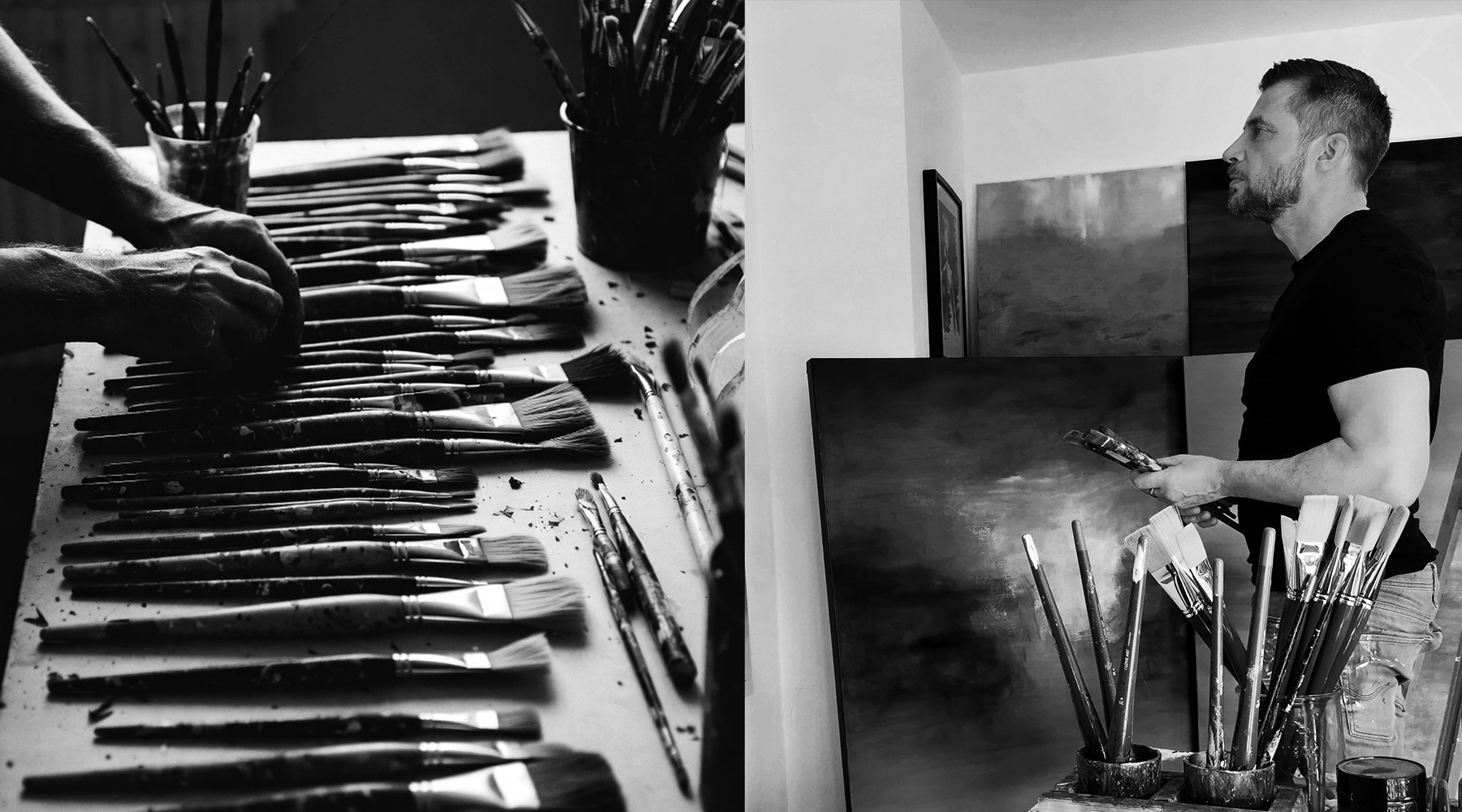
Christian Bahr is a German painter and draftsman, born in 1965 in Buxtehude, Lower Saxony. He has been working as a professional artist for more than 35 years, with works held in private and public collections worldwide. Educated in humanistic subjects, including classical languages, Bahr pursued academic studies before dedicating himself fully to painting. His artistic path was not linear. Years of exploration, reflection, and critical self-questioning shaped an independent position rooted in lived experience rather than in theory.
Alongside his artistic practice, Bahr gained professional experience in different international and institutional contexts. These encounters with political, historical, and social realities continue to inform his work, grounding it in a sober and unsentimental view of the human condition. Today, Bahr lives and works near Hamburg, Germany. His artistic practice focuses on large-scale paintings and works on paper, developed in the studio with sustained discipline and intensity.
Artistic Position
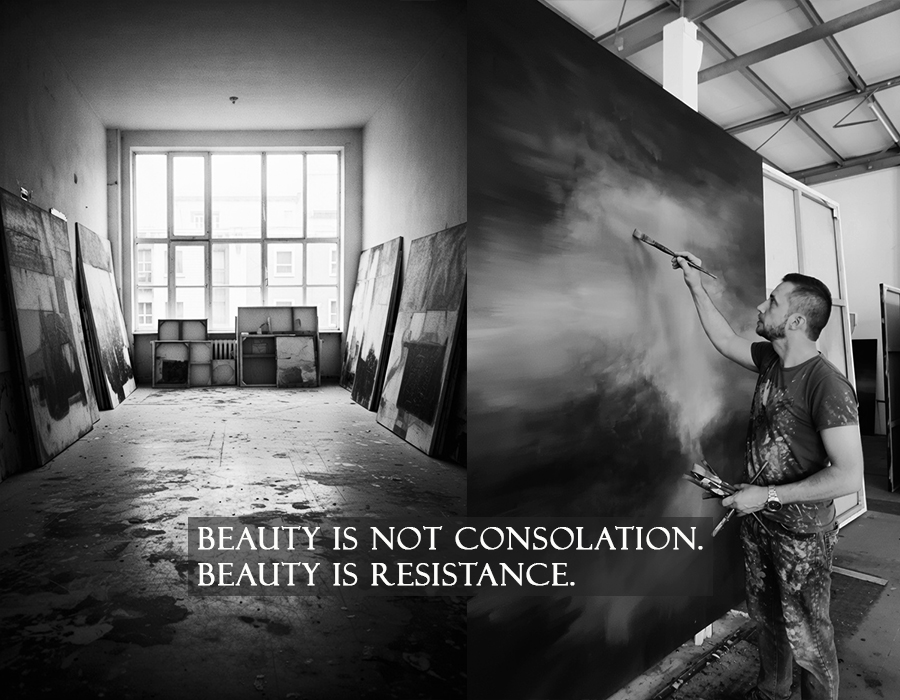
At the center of Christian Bahr’s work stands the human being — not as an illustration, but as a presence shaped by history, vulnerability, and inner conflict. His paintings emerge from intuition and direct engagement rather than conceptual construction. Bahr’s abstract-expressionist language is marked by reduction, physicality, and emotional concentration. Beauty is not understood as decoration, but as clarity and resistance. Darkness and light coexist, without irony or distance. Painting, for Bahr, is an existential act. It requires risk, commitment, and responsibility — toward the work, the viewer, and oneself. His art resists speed and consumption, inviting presence rather than immediate interpretation. These influences are not quotations, but currents — absorbed, transformed, and translated into an independent artistic language.
Selected Influences
Bahr’s work stands in dialogue with different artistic traditions, ranging from Classical Modernism to contemporary painting. Among his points of reference are artists such as Rembrandt, Caravaggio, J. M. W. Turner, Ernst Ludwig Kirchner, Egon Schiele, Edvard Munch, Pablo Picasso, Claude Monet, Joan Mitchell, Helen Frankenthaler, Gerhard Richter, Neo Rauch, Georg Baselitz, and Anselm Kiefer. Further inspirations arise from music, literature, theater, film, and nature. These influences are not quotations, but currents — absorbed, transformed, and translated into an independent artistic language.