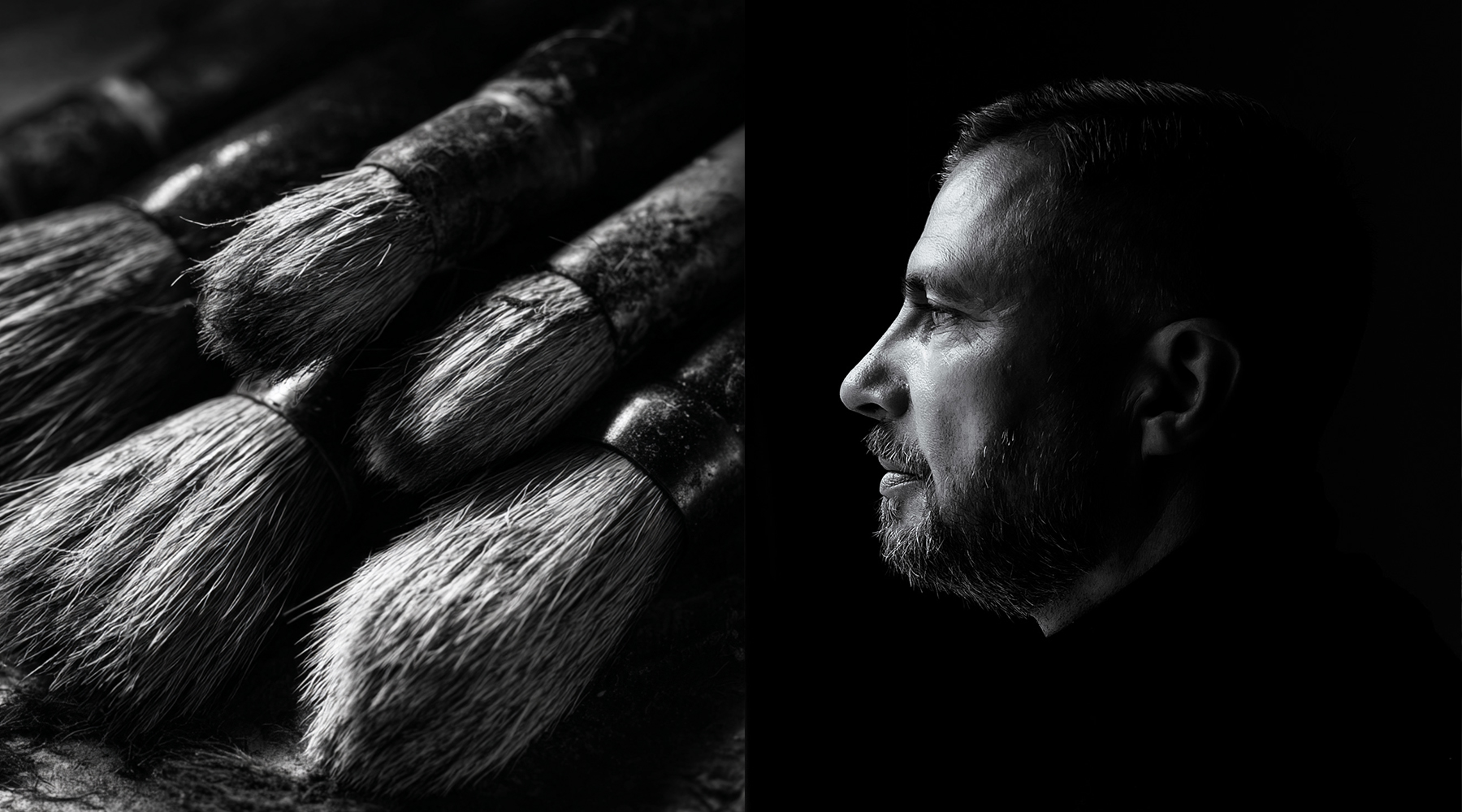
Why I Paint. How I Paint. What Painting Means To Me.
Painting is more than surface, color, or gesture. My understanding of Contemporary Abstract Expressionism is rooted in practice rather than theory — in intuition, risk, and the search for essence.
The human being stands at the center of my work. Not as a motif to be illustrated, but as a presence to be approached: vulnerable, conflicted, historical, and searching. My paintings do not arise from intellectual construction, but from lived experience, emotion, and sustained engagement with the world.
The following text reflects my artistic position, my process, and the questions that continue to shape my work.
Painting & Life / Process & Risk
Painting and life are inseparable. I do not believe in art as an intellectual construction detached from lived experience. Real life is the only serious teacher. Everything that enters my work — darkness, beauty, hope, fear — comes from direct experience, from observing people, history, and myself. I am not interested in cynicism. Darkness alone is not truthful. Light alone is not truthful either. Painting begins where both exist at the same time. I work intuitively and without sketches. The moment I begin to explain too much to myself, the work loses its necessity. Painting is risk. Every canvas is a decision without a safety net. I accept mistakes, resistance, even failure — because only then something real can happen. Control is not my goal. Presence is. Scale is not decoration. It is physical reality. A large painting confronts the viewer. It demands presence, just as life does.
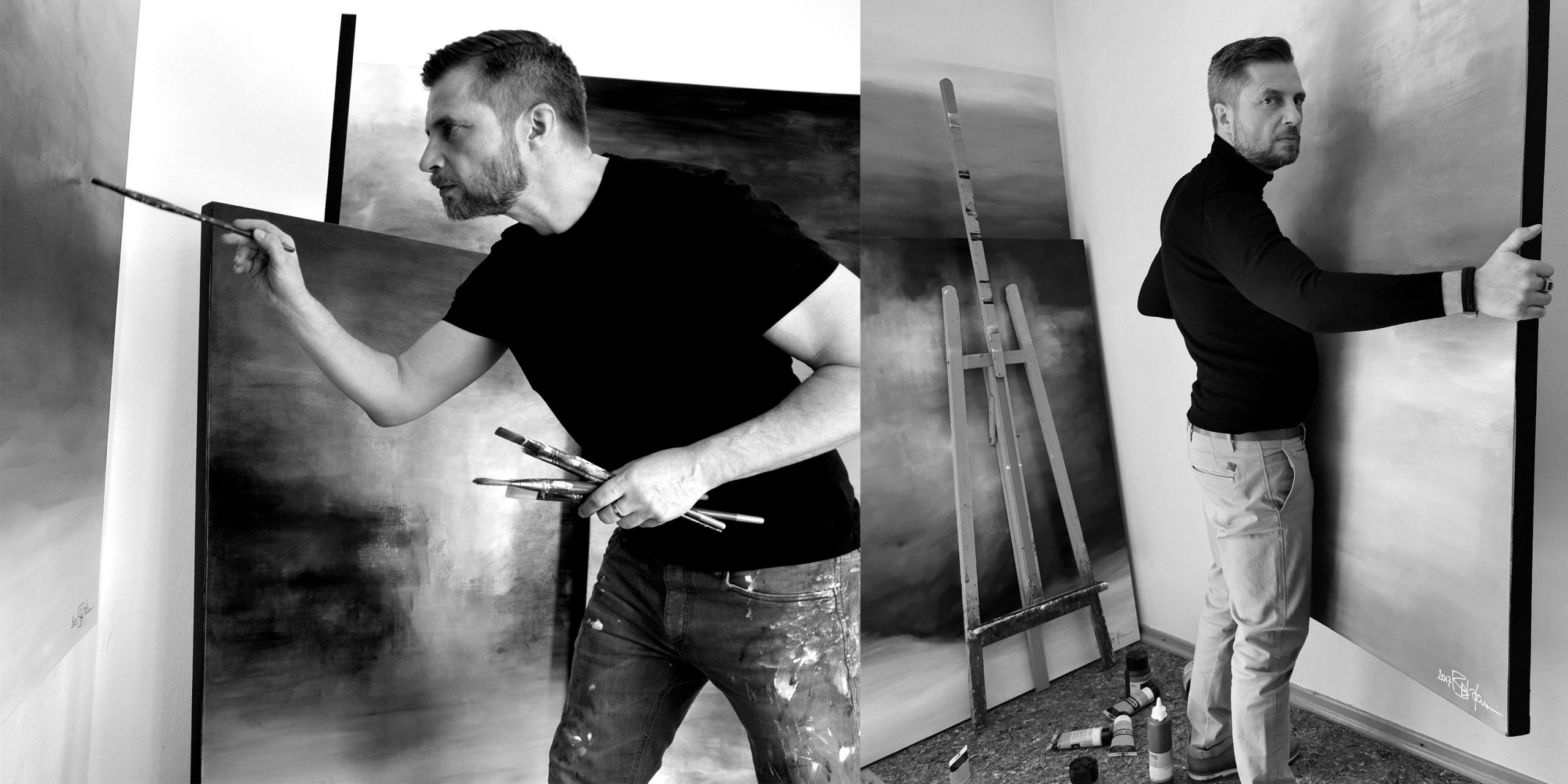
I work large because I want to stand inside the painting, not in front of it. The body must be involved. Painting is not a purely visual act; it is physical, emotional, sometimes exhausting. Only through this intensity can the work reach a level of honesty that interests me. Many contemporary positions rely on irony or concept. Irony, however, is often a defense mechanism. I am not interested in protecting myself from meaning. Painting, for me, is not a head-driven act. It is empathy, devotion, and struggle. It requires seriousness — not heaviness, but commitment. Spirituality, for me, is not a matter of confession or symbolism. It is an existential condition. I am interested in faith as an existential attitude, not as doctrine. Faith, doubt, hope, and transcendence are part of being human. Painting allows me to approach these questions without answering them. It creates a space where uncertainty is not weakness, but depth.
Spirit, Doubt & Responsibility
There is a spiritual dimension in my work, but not in a confessional or illustrative sense. I am not interested in belief as doctrine, nor in symbolism as explanation. What interests me is the existential condition of being human — doubt, hope, responsibility, vulnerability, and endurance. Painting allows me to approach these questions without providing answers. It creates a space where uncertainty is not a weakness, but a form of honesty. I am not searching for comfort, but for truthfulness. Not for transcendence as escape, but as confrontation.
I believe that seriousness in art is not a matter of weight or pathos, but of responsibility — toward the work, toward the viewer, and toward oneself. Painting demands attention, patience, and commitment. It resists speed and consumption. It asks to be encountered, not explained. In this sense, painting is not an object, but an event. A moment of presence. A shared experience between the work and the viewer, grounded in time, material, and human perception.
The Human Being, Beauty & Modernity
The human being stands at the center of my work. Not as a motif to be illustrated, but as a presence to be encountered. I am interested in the inner and outer conditions of human existence — memory, history, fragility, dignity, and endurance. I do not believe that beauty is obsolete. On the contrary: in times marked by acceleration, irony, and detachment, beauty becomes a form of resistance. Not as decoration or consolation, but as intensity and clarity. Beauty, for me, is not the opposite of darkness. It is what allows darkness to be seen without surrendering to it.
Modernity is often understood as rupture, provocation, or negation. I do not share this understanding. I believe that painting remains contemporary when it takes its subject seriously — when it engages with the human condition without irony, without distance, and without fear of depth. Abstraction, in my work, is not a retreat from reality. It is a way of approaching it. By reducing form, color, and gesture, I seek concentration rather than explanation. The less is shown, the more must be perceived. Painting, therefore, is not a comment on the world. It is participation in it.
Time, Transience & Memory
Time is an essential element of my work. Nothing that interests me is static. Everything exists in relation to duration, disappearance, and remembrance. Painting allows me to engage with this condition — not by fixing it, but by acknowledging its fragility. I am drawn to what remains after certainty dissolves: traces, residues, echoes. Memory is never complete; it is layered, fragmented, and subjective. In this sense, painting does not preserve time. It accepts loss. It works with what cannot be held.
Melancholy plays a role in this process, but it is not resignation. It is attentiveness. A way of looking closely at what passes, without turning away. What matters to me is not nostalgia, but awareness. Painting becomes a form of slowing down. A resistance against disappearance through presence. Each work exists in a precise moment — shaped by material, gesture, and attention — and carries within it the knowledge of its own impermanence.
Art & Market
Art exists within a world that includes institutions, collectors, and markets. I do not deny this reality, but it does not define my work. What matters to me is the integrity of the artistic process and the responsibility that comes with it. A painting carries its own value before it enters any market. Price may reflect recognition or commitment, but it does not determine meaning. My responsibility is not to produce objects of demand, but to remain truthful to the work itself.
I see the relationship between artist and collector as one of trust. A painting changes hands, but it does not lose its origin. It remains bound to the conditions under which it was created — to time, intention, and presence. In this sense, painting is not a commodity first. It is an encounter. Everything else follows.